

The world runs on entities,
We make them computable.
Registry Protocol for registering companies and other entities onchain.
making them programmable and composable and remain backward-compatible with state compliance.
01
❍
Trust Neutral Social Fabric
02
1 Billion+
Proto Entities, Pre-formal ventures relay on handshake and trust, we give them a structure
03
359 Million+
Legal Entities, incorporated worldwide, we make their bylaws machine executable
04
70 Million+
Autonomous Entities, new economic actors faster than law can handle. we make them legally legible.
Entities power the world — but they still run on PDFs and trust.
Entities define how people organize, own, and govern. They exist everywhere — but they aren’t computable.
Non-Computable Entities
Entities power the economy, but their rules live in documents and legal language. Software can’t read, verify, or execute how an entity is meant to behave
Trust-Based Enforcement
Entity rules are legally binding, yet enforced manually through people and institutions. This makes governance slow, fragile, and dependent on trust instead of code.
Fragmented Identity
The same entity appears differently across registries, banks, and blockchains. There’s no universal way to verify who an entity is, who owns it, or how it’s governed.
Frontier Mismatch
New entities like DAOs, AI agents, and autonomous systems don’t fit legacy frameworks. They need coordination and accountability, but existing registries weren’t built for them.
01
Faithful-by-Construction
Turn intents, bylaws, shareholder agreements, and governance rules into deterministic execution logic
Legally Binding → Computationally Binding
.png&w=3840&q=75)
02
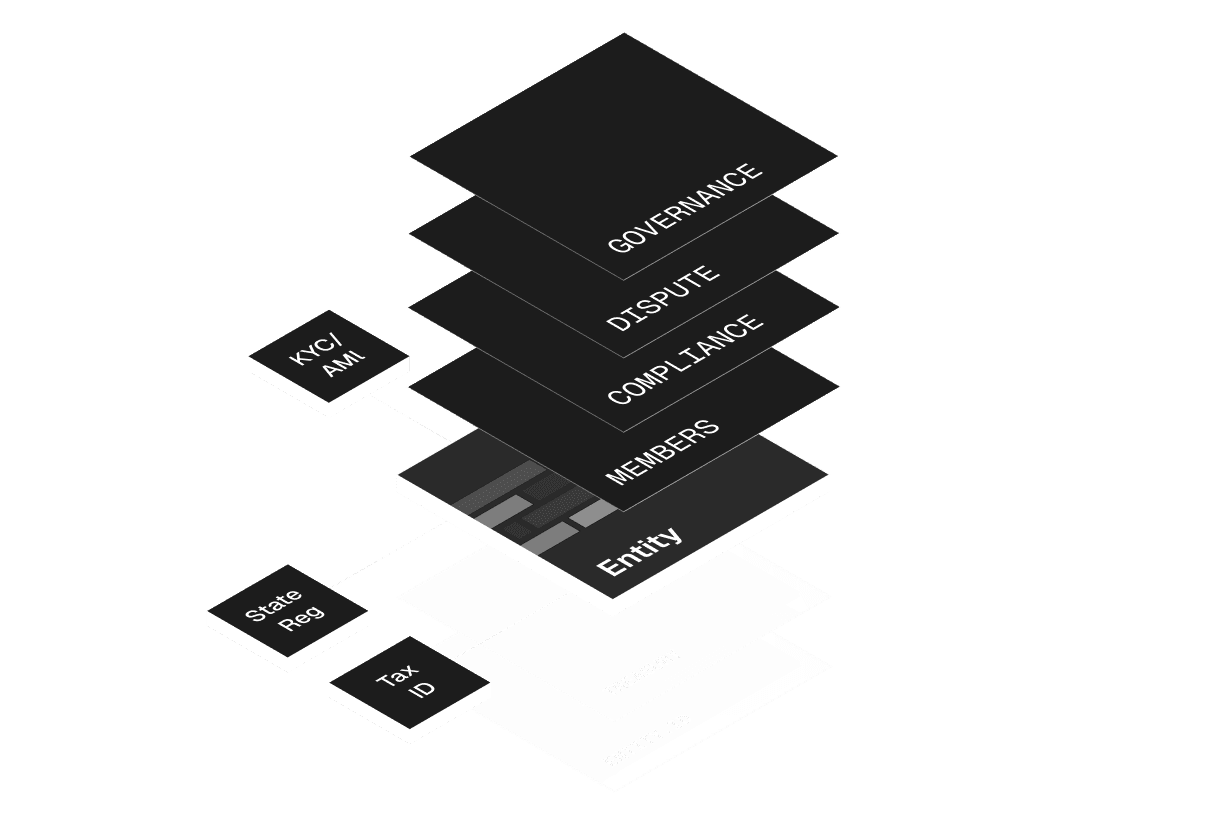
Compliance-by-Modularity
Composable modules of compliance, from Jurisdictional Conformity, Licenses to taxID to policies
- KYC, AML, and credential verification
- Portable and reusable across jurisdictions
- Set, manage, and enforce compliance policies directly
- Backward-compatible with existing legal systems
03
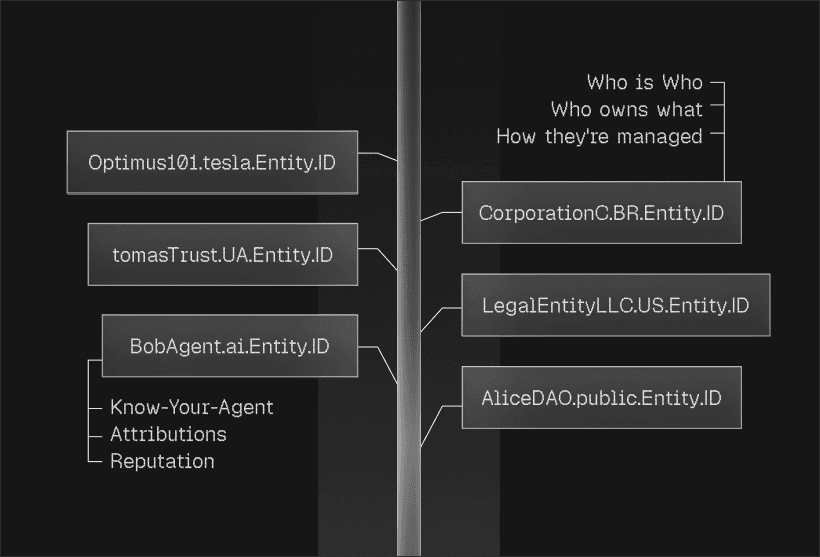
Universal Entity.ID
A single, information-rich smart identifier for every entity
Verifies who an entity is, who owns it, and how it’s governed — across jurisdictions and blockchains
.png&w=3840&q=75)
RegistryChain standardizes how entities are identified and governed.
One identity, one source of truth — enforced by code, recognized by institutions.
Features & Infrastructure For
01
Founders & Companies
Incorporate, co-found, and operate ventures with computable rules instead of trust assumptions. Make equity, control, and decision rights explicit, transparent, and enforceable.
02
DAOs & Web3 Organizations
Operate as blockchain-native entities with real-world legibility. Preserve autonomy while gaining compliance interfaces and institutional compatibility.
03
Banks & Institutions
Access a single, verifiable source of entity identity, ownership, and governance. Streamline KYB, AML, onboarding, and continuous monitoring with portable, machine-readable credentials.
04
Regulators & Registrars
Gain programmable visibility into entity formation, amendments, and governance state. Enable real-time compliance, auditability, and jurisdictional interoperability.
05
Investors & Funds
Verify cap tables, governance structures, and entity legitimacy instantly. Reduce diligence friction and structural ambiguity across jurisdictions.
06
Associations & Clubs
Digitize membership, voting, and governance rules. Transform informal coordination into structured, verifiable organization.
07
Pre-Formal Ventures
Structure early collaboration before incorporation. Define roles, equity intent, and decision rights without immediately forming a company.
08
Frontier & Emerging Entities
Support AI agents, autonomous systems, and new organizational forms. Enable coordination, accountability, and recognition beyond legacy frameworks.
We’re building the infrastructure every entity will run on.
RegistryChain standardizes entity identity and governance so coordination can scale globally, securely, and autonomously.